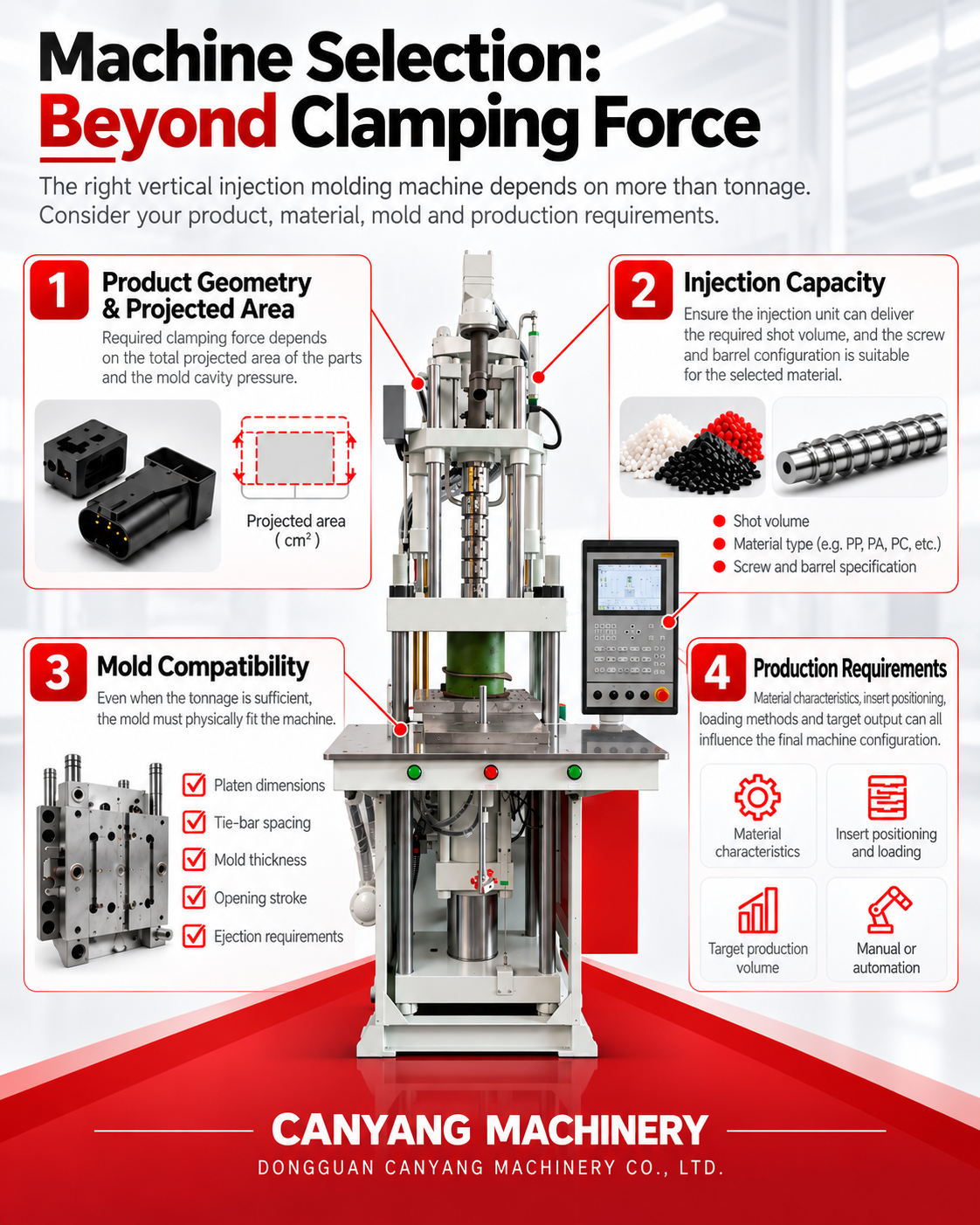

An equipment selection guide covering clamping force, injection capacity, mold compatibility, and production requirements.
Choosing the right vertical injection molding machine is an important step in achieving reliable production, consistent product quality, and cost-effective manufacturing.
For many buyers, the selection process begins with one question:
"What clamping force do I need?"
For example, a manufacturer may ask whether a 35-ton or 45-ton vertical injection molding machine is suitable for a particular product.
While clamping force is an essential specification, it is not enough to determine whether a machine will meet the application's requirements.
The right machine must match the product, plastic material, mold design, and production process.
This guide explains four key factors manufacturers should evaluate before selecting a vertical injection molding machine.
1. Evaluate Product Geometry and Required Clamping Force
Clamping force is one of the first specifications to consider when selecting an injection molding machine.
Its primary function is to keep the mold closed against the opening forces generated by cavity pressure during injection and packing.
However, the required clamping force is not determined simply by product weight or overall dimensions.
Several factors must be considered:
-
Projected Area: The total projected area of the molded parts and relevant runner system in the mold-opening direction.
-
Cavity Pressure: The effective pressure acting inside the mold during the molding process.
-
Number of Cavities: Multi-cavity molds may require greater clamping force because of their combined projected area.
-
Material and Part Design: Material flow characteristics, wall thickness, gate location, and flow length can influence cavity pressure.
A preliminary engineering estimate follows the relationship:
Required Clamping Force ≈ Total Projected Area × Effective Cavity Pressure
Appropriate unit conversion and a suitable operating margin must be applied.
Importantly, the effective cavity pressure used for this calculation is not necessarily the same as the injection pressure displayed by the machine.
Why Does This Matter?
Two plastic parts with similar weights may require different clamping forces because their projected areas and molding conditions are different.
Selecting a machine based only on product weight or nominal tonnage can therefore lead to incorrect equipment sizing.
Practical recommendation: Before choosing a machine, obtain the product drawing, plastic material information, mold cavity count, and projected area whenever possible.
2. Check Injection Capacity and Material Compatibility
Even when a machine offers sufficient clamping force, its injection unit must also be capable of processing the required material and delivering the appropriate shot volume.
The main considerations include:
Injection Volume and Shot Size
The required shot volume should include both the molded products and any runner material.
The injection unit must provide sufficient capacity while operating within a suitable shot-size range for the material and process.
An excessively small shot may increase material residence time, while a shot that approaches the injection unit's maximum capacity may leave insufficient processing flexibility.
Injection Pressure and Speed
Different products and materials require different filling conditions.
Thin-wall components, long flow paths, and complex geometries may demand higher injection pressure or specific injection-speed capabilities.
Screw and Barrel Configuration
Material selection also affects the injection unit.
Common thermoplastics and reinforced engineering plastics can have significantly different processing requirements.
For example, glass-fiber-reinforced materials may require more wear-resistant screw and barrel configurations than standard unfilled polymers.
Practical recommendation: Confirm the material grade, estimated shot weight, and processing requirements before finalizing the injection unit.
A machine with sufficient clamping force may still be unsuitable if its injection capacity or plasticizing performance does not match the application.
3. Confirm Mold Compatibility
A machine may provide adequate clamping force and injection capacity, but the mold must also be mechanically compatible with the equipment.
This is especially important when manufacturers intend to use an existing mold with a newly purchased machine.
Key specifications include:
-
Platen Dimensions: Can the mold be properly mounted and supported?
-
Tie-Bar Spacing: Does the mold fit between the tie bars, where applicable?
-
Mold Thickness Range: Is the mold thickness within the machine's supported range?
-
Opening Stroke and Daylight: Is there enough clearance for mold opening and product removal?
-
Ejection Requirements: Can the machine accommodate the mold's ejection method?
-
Mold Weight and Interfaces: Can the machine support the mold and provide any required connections or auxiliary functions?
Mold dimensions must be reviewed together with the machine's actual installation and operating clearances.
Why Does This Matter?
A mold that is incompatible with the machine may require modifications, additional investment, or an entirely different machine configuration.
Practical recommendation: Share the mold drawing and key mold dimensions with the equipment manufacturer before confirming the machine model.
4. Match the Machine Configuration to Production Requirements
Vertical injection molding machines are widely used for applications involving metal inserts, electrical connectors, cable overmolding, and other components that require insert placement.
However, different applications may require different working-table configurations.
Fixed-Table Vertical Injection Molding Machines
Fixed-table configurations are often suitable for applications where a stationary mold arrangement meets the production and operating requirements.
They may be an appropriate choice for relatively straightforward manufacturing processes.
Sliding-Table Vertical Injection Molding Machines
Sliding-table machines allow the lower mold to move outside the clamping area, improving accessibility for insert loading and part removal.
Double sliding-table configurations can also allow one station to be prepared while another station is molding, helping reduce machine waiting time.
Rotary-Table Vertical Injection Molding Machines
Rotary-table machines use indexed rotation to move mold stations between operating positions.
Depending on the tooling and station arrangement, loading and molding operations can overlap to support a more continuous workflow.
Rotary-table systems may also be considered for applications requiring higher output or future automation.
However, a rotary table is not automatically faster or more suitable than a sliding-table configuration.
The complete cycle time, insert-loading complexity, available workspace, and equipment investment must be evaluated together.
Why Does This Matter?
The most suitable configuration depends on how the machine will actually be used.
A higher-specification machine does not necessarily deliver better production economics if its features do not match the workflow.
Practical recommendation: Evaluate production volume, loading time, operator access, and future automation needs before choosing a fixed-table, sliding-table, or rotary-table machine.
5. Consider Total Manufacturing Cost
Machine selection should also include an evaluation of long-term operating requirements.
A larger or more complex machine may increase initial investment without providing meaningful advantages for the intended product.
Conversely, equipment that lacks sufficient capacity may limit production performance or require additional investment later.
Manufacturers should consider:
-
Initial equipment and tooling investment
-
Expected production volume and cycle time
-
Energy consumption under actual operating conditions
-
Maintenance and spare-parts requirements
-
Operator involvement and potential automation
-
Future production flexibility
The objective is not to purchase the largest or most advanced machine available, but to choose equipment that provides the required capability at an appropriate total cost.
Vertical Injection Molding Machine Selection Checklist
Before requesting a quotation or confirming a machine configuration, manufacturers can prepare the following information.
| Category | Information to Prepare |
|---|---|
| Product | Product images, dimensions, drawings, and intended application |
| Material | Plastic material type, grade, and any reinforcement or special processing requirements |
| Mold | Mold dimensions, weight, cavity count, projected area, and existing mold drawings |
| Injection | Estimated product and runner weight per shot |
| Clamping | Estimated cavity pressure or available molding data, if known |
| Production | Required daily or monthly output and target cycle time |
| Operation | Manual insert loading, sliding table, rotary table, or automation requirements |
| Utilities | Available electrical supply, cooling facilities, and auxiliary equipment |
Not every project will have complete technical information at the initial inquiry stage.
However, providing more accurate product and mold details allows the equipment manufacturer to recommend a more suitable machine configuration.
Conclusion: Choose the Machine Around the Application
Choosing a vertical injection molding machine requires more than comparing clamping-force ratings.
The four key technical considerations are:
1. Product geometry and required clamping force
2. Injection capacity and material compatibility
3. Mold dimensions and mechanical compatibility
4. Production requirements and working-table configuration
These factors should be evaluated alongside equipment investment and long-term operating costs.
The best machine is not necessarily the largest or most advanced one. It is the one that matches the actual manufacturing application.
Looking for the Right Vertical Injection Molding Machine?
CANYANG MACHINERY manufactures vertical injection molding machines for applications including insert molding, cable overmolding, electrical connectors, and industrial plastic components.
Our machine configurations include fixed-table, sliding-table, and rotary-table options to accommodate different manufacturing requirements.
If you are evaluating equipment for a new product or an existing mold, our team can help review the product dimensions, material specifications, mold requirements, and expected production conditions to identify a suitable configuration.
Contact CANYANG MACHINERY to discuss your application and machine selection requirements.
DONGGUAN CANYANG MACHINERY CO., LTD.